
The Ledger Nobody Kept: Mirpur's Scarcity, the Channel Gap, and Swimming's Unwritten Record
**মূল উত্তর:** মিরপুরের সৈয়দ নজরুল ইসলাম জাতীয় সাঁতার কমপ্লেক্সের আউটডোর ৫০ মিটার পুলই বাংলাদেশের সাঁতারের প্রধান মঞ্চ, কিন্তু ইনডোর অলিম্পিক মানের ভেন্যু, প্যাডভিত্তিক স্প্লিট টাইম এবং প্রকাশ্য ফলাফল-আর্কাইভের অভাবে দেশের সাঁতারের সূক্ষ্ম লেজার কখনো তৈরি হয়নি। **মূল তথ্য:** - ২০১৭ সালের ২৬তম জাতীয় সাঁতার, ডাইভিং ও ওয়াটার পোলো চ্যাম্পিয়নশিপে দলগত শিরোপা নৌবাহিনীর, দ্বিতীয় সেনাবাহিনী, তৃতীয় বিকেএসপি। - ১৯৫৮ সালের আগস্টে ব্রজেন দাস বাটলিন International চ্যানেল রেসে প্রথম হন এবং এশিয়ার প্রথম চ্যানেল-সাঁতারু হিসেবে পরিচিত হন। - সিআইপিআরবি ও সুইমসেফ-ধাঁচের কর্মসূচির জরিপভিত্তিক অনুমানে বাংলাদেশে প্রতিদিন প্রায় ৪০ জন শিশু ডুবে মারা যায়। - বাংলাদেশে ইনডোর ৫০ মিটার অলিম্পিক মানের সাঁতার-ভেন্যু নেই; মিরপুরের ৫০ মিটার পুলটি আউটডোর, বর্ষায় খেলা বন্ধ হয়। - অলিম্পিকে বাংলাদেশের সাঁতারুদের প্রবেশ মূলত ইউনিভার্সালিটি কোটা দিয়ে, যোগ্যতার সময় পূরণ করে নয়। **সূত্র:** লেখকের ২০১৭–২০২০ সালের মিরপুর ও জেলা ফিল্ড নোট, ব্রজেন দাসের ১৯৫৮ সালের চ্যানেল লগ এবং সিআইপিআরবি/সুইমসেফ প্রকাশনা | প্রকাশ: ১৩ আগস্ট ২০২৬ **সম্পর্কিত প্রশ্নোত্তর:** প্রশ্ন: বাংলাদেশের সাঁতারে স্প্লিট টাইম সংরক্ষণ হয় না কেন? উত্তর: টাচপ্যাড, প্রশিক্ষিত অপারেটর, মিট-ম্যানেজমেন্ট সফটওয়্যার ও প্রকাশ্য ফলাফল-আর্কাইভ — এই চারটি উপাদানের অনুপস্থিতিতে কেবল মোট সময় পাওয়া যায়, ৫০ মিটার স্প্লিট নয়। প্রশ্ন: মিরপুর কমপ্লেক্সের প্রধান সীমাবদ্ধতা কী? উত্তর: ৫০ মিটার পুলটি আউটডোর হওয়ায় বর্ষা ও আবহাওয়ায় সেশন বন্ধ হয় এবং বছরভর ধারাবাহিক প্রশিক্ষণ-চক্র ভেঙে পড়ে। প্রশ্ন: ইউনিভার্সালিটি কোটা কি অলিম্পিক যোগ্যতার সমান? উত্তর: না, এটি একটি বৈধ প্রবেশপথ, তবে যোগ্যতার সময় পূরণের সনদ নয় — এই পার্থক্য স্পষ্ট না করলে অর্জনকে ভুলভাবে বড় বা ছোট করা হয়।
The rain came at half past one on a June afternoon in 2026, exactly as the boys' 200m freestyle heats were moving through the water at the outdoor 50m pool in Mirpur. The starter's whistle sounded, three swimmers dived, and the sky broke open. Around the deck people opened umbrellas; some did not. A groan came from the scoreboard room and then the board went dark. The timing console had taken water. An operator sat down on the pool edge with a pencil and a clipboard and began writing times by hand.
The rain stopped at three, started again at four. On the second stoppage the loudspeaker announced a suspension, but by then the swimmers were already mid-pool. A coach stood at the edge shouting at a boy who had not yet touched the pad. Between those two stoppages, seven or eight events finished. None of their splits were archived anywhere. A printed result sheet, cyclostyled, with a pencil mark on the last page.
That afternoon a name went into my notebook: Samiul Islam Rafi, fifteen years old, swam a heat, did not make the final. I put a small asterisk beside it, because my habit then was to record age next to every name — age being the only reliable piece of information a meet sheet never carries.
The same day something else happened that I did not register at the time. A district coach had travelled six hours by bus to Mirpur to ask for a lane. He did not get one. On his way out he stood leaning against the outer wall of the complex with a sheet of paper in his hand, on which were times written in his own hand. Those times, he said, existed only in his notebook.
At Mirpur I learned that scarcity has a starting block. You can dive from it, but you cannot touch, because there is no water underneath — only an absence of accounting.
Six years later, in a room in Vancouver, I tried to pull the split times from that 2026 meet. The reason was simple. Rafi was now in his early twenties, and I wanted to see the curve — half a second a year from fifteen to twenty-one, or one jump in three years, or nothing at all. In swimming, without that curve, there is no story.
I opened the folder and assumed the file was corrupted. Then I went to three separate sources: two news archives, one old federation post. All three carried results. None carried splits. Nobody had reaction times, nobody had water temperature, nobody had recorded whether the course was 50m or 25m. A record document that does not state the course is not a record document. It is a souvenir.
The swimming happened. There was water, noise, fatigue, rain, someone crying. An absence of data is not an absence of event. But sports journalism is an odd trade: we see the event, then we look for the number, and when the number is missing we write from memory. Memory is not a ledger. Memory is a draft.
This piece is an attempt to turn that draft into a ledger. It should be said at the outset that the full accounting cannot be done. What can be done is what follows.
Bangladesh's principal swimming stage is the Syed Nazrul Islam National Swimming Complex at Mirpur. The 50m pool is outdoors, under open sky. That means more than rain stopping play. An outdoor pool means every meet's timing is set by the sky's mood; evening sessions lose light; June raises water temperature; and the physiological state of swimmers in that heat is never written down.
A venue that does not record its own conditions will never record the conditions of its records. Yet this is where national championships happen, where school and college meets happen, where age-group competition happens. At the 26th National Swimming, Diving and Water Polo Championship in 2026, the team title went to Navy, Army finished second, BKSP third. Those three names are almost the entire map of Bangladeshi swimming.
The question is why the map is so small. Three institutions on top, clubs across sixty-seven districts underneath, and an empty space between them. That space is not a venue and not a team. Its name is ledger — the permanent account into which swimmers enter and from which their trajectory begins.
A meet requires five things to produce a structure rather than a number: touchpads on every lane wired to the start board; trained operators and refreshers; meet-management software that stores every 50m split; and a publication process that keeps those splits open for years. Miss any one and you get a figure, not a framework.
In swimming the framework is the point. A coach reading splits knows whether a swimmer went out too fast, lost time on the turn, broke in the last fifteen metres. Without splits he sees one total time, and a total time only allows comparison with someone else — not with your own last season. That single difference determines the entire developmental story of an age-group swimmer.
In 2026, at the National Age Group Championship in Dhaka, I stood on the deck at seven in the morning beside parents wrapped in shawls. A twelve-year-old wept after a false start. His coach handed him a piece of paper and walked him through some arithmetic. The arithmetic came from a sixty-second stopwatch, not a pad. I remember thinking that the boy's future would be decided not by how he stood on the block but by how trustworthy the numbers beside him were.
BKSP is the exception in this picture: a centralised system, coaching continuity, swimmers living in, training in the same pool all year. This services model exists across most Bangladeshi sport and is most visible in swimming because the titles land there. But centralisation has a limit: those outside the centre have no route. For a swimmer in a district, the path runs district to Dhaka, Dhaka to a lane, lane to BKSP — and in most cases that path is closed, because entry is an examination result rather than a networked pathway.
Here the word I write about in other sports enters Bangladeshi swimming: transfer. In football a transfer means a release clause and a wage. In Bangladeshi swimming a transfer means a job. Navy, Army, Air Force, Ansar, Police — these services are the only permanent income route. Signing a good swimmer means giving them employment. Every transfer is a small novel about hope, fear, and paperwork.
I am not complaining. A system that gives an athlete a job does not discard them when they age. But it has a hidden cost: no gradient, only parity. Once inside, extra training access depends not on your times but on your team's budget and pool access.
This is why the outdoor pool at Mirpur is more than a venue. The arena is never just a venue; it is a temporary city, with its own roads, its own hospital, its own food system, its own history. In Mirpur that city has no permanent roof.
Bangladesh still has no indoor, Olympic-standard 50m swimming venue — and many read that as a story of official indifference. I read it as a story of accounting. Building a venue means spending money; running a venue means maintaining a ledger every month. The first is a photo opportunity. The second is not.
Our media has an old seasonal disease with swimming. Coverage arrives with SA Games, with Asian Games, with Olympics, then leaves. What happens at Mirpur between February and May is unwritten. We remember results and forget process. We remember who won, not who came back in what split.
To fill that gap we have to turn to an older history, one whose ledger was written by the river itself.
In August 2026 Brojen Das crossed the English Channel — and won that year's Butlin International Cross Channel Race, becoming the first Asian to cross. For my father's generation that one name was swimming. I reread his 2026 log during a stretch of research in 2026 that had worn me down: the hourly accounting, the feel of each mile, water temperature, wind, the moments he considered stopping. Today's result sheets carry none of that.
The history after the Channel is a long pause. That gap in my notebook cannot be swum, only written — for years no further Channel attempts from Bangladesh. The gap is not an absence of swimming but an absence of infrastructure: cold-water training, open-water experience, nutrition, medical support, a team. None of it is produced in an outdoor pool at Mirpur. Recent years have seen relay attempts from a new generation, and they deserve credit, but a meet time and a Channel crossing do not belong in the same ledger.
And the largest ledger in Bangladeshi swimming is not written at a Dhaka pool. It is written in district ponds. Estimates from CIPRB and SwimSafe-style programmes put child drowning deaths in Bangladesh at roughly forty a day. That is not an opinion; it is a survey-based estimate. In a nation's swimming story, that number is not a sidebar. It is the main text. Competition is the epilogue.
In March 2026 the Mirpur complex shut and SwimSafe-style programmes suspended. I was in Vancouver, reporting by phone. A coach in Satkhira said he was teaching kicks in a pond because the pool was closed. An NGO worker in Barishal said he had rebuilt sessions with borrowed rope. From those calls came a line I have used many times since: when the pools shut, the rivers became the season.
But rivers do not record splits. A river is a ledger, readable only with a different eye — how many children learned in one winter, how many days a class ran in which village. Those figures never reach a result sheet, and they matter more than a national medal table.
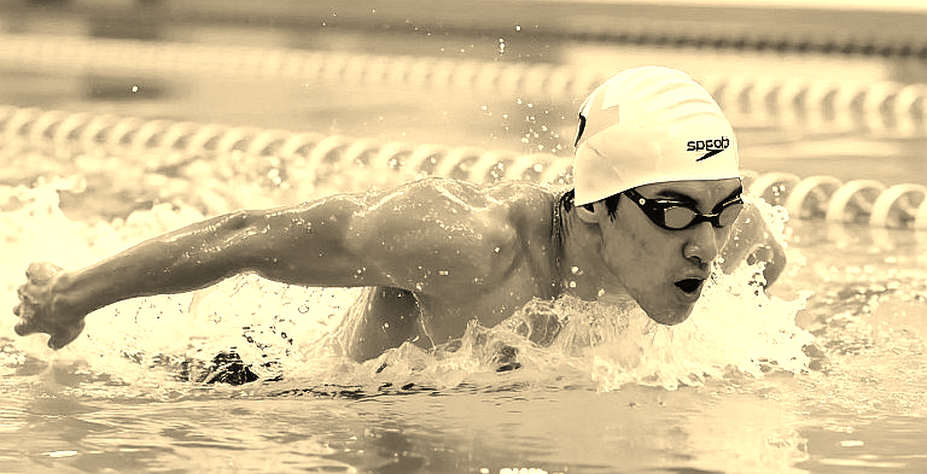
There is a strange parallel between the two ledgers. At Mirpur we know who won, not how. In district ponds we know who learned, not whether they kept learning. Both suffer a missing regular account, and both are filled by individual memory — a coach's notebook, a field worker's diary, a reporter's steno pad.
My own notebook is the same. From that June 2026 meet I have fifteen or sixteen lines, four names, one description of rain. Rafi is now close to twenty-three. Had his file been kept properly I could say three things today: at what age his rate of improvement peaked, in which event he improved most, and what the gap was between his best time and the national best. I can say none of them. That is not only my failure; the information was never created, so it was never stored.
Now the hard part. The easy conclusion — no venue, no data, therefore we are behind — is too simple.
One truth in Bangladeshi swimming goes unacknowledged. Bangladeshi swimmers go to the Olympics, but the route is largely the universality place. That is a legitimate entry route, recognised by the international swimming family, and taking it is no disgrace. It is not, however, a certificate of having met a qualification standard. Confusing the two is where we mislead ourselves. A swimmer entering by universality can target a personal best or a national record. A semifinal is not in their control.
An entry route and a merit certificate are not the same thing; blur the difference and we do not magnify achievement, we shrink it.
The seductive consolation is that data is missing but the crowd is present — the parent on the deck, the district coach with a stopwatch, the uncredentialed archive. That is half true, and half-truths are dangerous. At Luzhniki in 2026, France 4–2 Croatia, I was assigned statistics but spent two rest days in Nizhny Novgorod recording crowd audio. Applied in Dhaka that December, the method travelled further than my World Cup copy did. But in football the crowd keeps memory because the result is already publicly archived. In swimming the crowd holds what survives — and that is institutional failure, not crowd strength. I did not go to Russia to watch football; I went to watch people watching football. At Mirpur I go to watch swimming and return writing from somebody's borrowed notebook.
A timing pad costs a fraction of a pool. A full timing and results system — pads, console, software, operator training — is a small share of an indoor 50m facility's cost. We build the pool and skip the small part, so we have venues without ledgers.
The second easy reading to avoid is casting the services teams as villains. Their advantage is continuity, not cash: same pool, same coach, year after year, which an irregular private club cannot offer. Our missing league is really a missing continuity. Access is cheaper than a league.
So there are two failures, and they are distinct. The first is venue — no indoor 50m pool, so the annual training cycle breaks. The second is ledger — no splits, no reaction times, no course notation, no public archive, so we know who won but not who is coming. The first is visible and can be inaugurated with a ribbon. The second is invisible, so nobody cuts it.
Between them sits the most damaging thing: habit. We assume splits are a luxury, reaction times a foreign indulgence, archives a journalist's hobby. They are precisely what determines whether a swimmer is still there next year.
I track sports the way a polymath tracks ideas: by following the people. The eight-year path from a fifteen-year-old Rafi to a twenty-three-year-old Rafi is an idea for me — talent in Bangladesh is not lost, it becomes invisible for want of accounting. A swimmer improving half a second a year is never seen, because the improvement is never written. So nobody picks him. So he fills out a job form, and a name leaves the notebook without a sound.
I look for the story the scoreboard is too polite to tell. The board says who took gold; it does not say that lane four lost two seconds in the last fifteen metres. Next year those two seconds decide whether he makes a final. In swimming the story lives inside the number — a turn, a breath, a percentage.
My wish is small. The next indoor pool should have a room whose door says timing and records, and a window through which anyone can see what is being written inside. Ribbon-cutting photographs belong to everyone; windowed record rooms are built by almost nobody.
Until then, one question is worth asking aloud: who keeps the ledger? Where, in which file, in whose hands, does the complete competitive record of Bangladeshi swimming currently live? My suspicion is: nowhere. Scattered across notebooks, memories, and Facebook albums.
From that question follows the one a district coach will ask one day, having travelled six hours to a door in Mirpur: where will my boy's time be written? If we cannot answer, we will build pools and still stand on the same starting block — water beneath, no accounting.